Playbook
Golf Membership Models That Work: Sims, Ranges & Courses (2026)
The short answer
A good golf membership turns a fair-weather visitor into a regular who has already paid before they have even left the house. Get it right and you swap a lumpy diary of one-off bookings for steady, predictable monthly revenue — and a group of customers who feel like they belong to the place.
The catch is that an indoor golf simulator, a driving range and an 18-hole course are genuinely different jobs, and a membership that fits one can be daft for another. So below we cover what “normal” actually looks like for each in 2026, the five models that do the heavy lifting, what to charge, and how to run the whole thing in BookMyBays without keeping it all in a spreadsheet held together with hope.
What “normal” looks like in 2026
Prices vary wildly by location and kit, so treat these as the shape of the market rather than gospel. The point is the structure — once you see the patterns, your own numbers fall out of them.
Indoor golf simulators
This is the most membership-hungry corner of golf, because the venue is open all year and the bays are empty the moment nobody books them. Monthly subscriptions are the norm — commonly somewhere between £80 and £250 a month, with the popular middle tiers landing around £150–£200. Plenty of venues sell hours or credits rather than raw “unlimited” — say eight or twelve bay-hours a month — and almost everyone offers a cheaper off-peak tier for weekday mornings, when otherwise the place echoes.
The rule of thumb members do in their heads: unlimited starts paying for itself at roughly eight to ten hours of play a month. Price yours so the keen ones feel clever signing up, and the very keen ones feel like they are getting away with something.
Driving ranges
Ranges have quietly run memberships for decades — they just call them ball cards. The two dominant shapes are an unlimited-balls plan (commonly around £40–£100 a month) and a top-up credit card, where loading £50 might get you £60 of balls — a discount dressed up as generosity, which is exactly how it should feel. A one-off annual range pass (around the £100 mark) is common too. Bays on a Toptracer-style range work the same way, just at a higher price point.
Golf courses
Courses are the traditionalists, and their memberships show it. The classic trio is 7-day (full), 5-day (weekday), and increasingly a flexible, points-based membership where you buy a points balance and spend it per round rather than paying for unlimited golf you will never get round to playing. Full membership tends to make sense for anyone playing 35-plus rounds a year; below that, flexi and off-peak “academy” memberships — play after 1pm on weekdays, after 2pm at weekends — pick up the golfers who do not want to fund a clubhouse they rarely sit in.
The five membership models that do the work
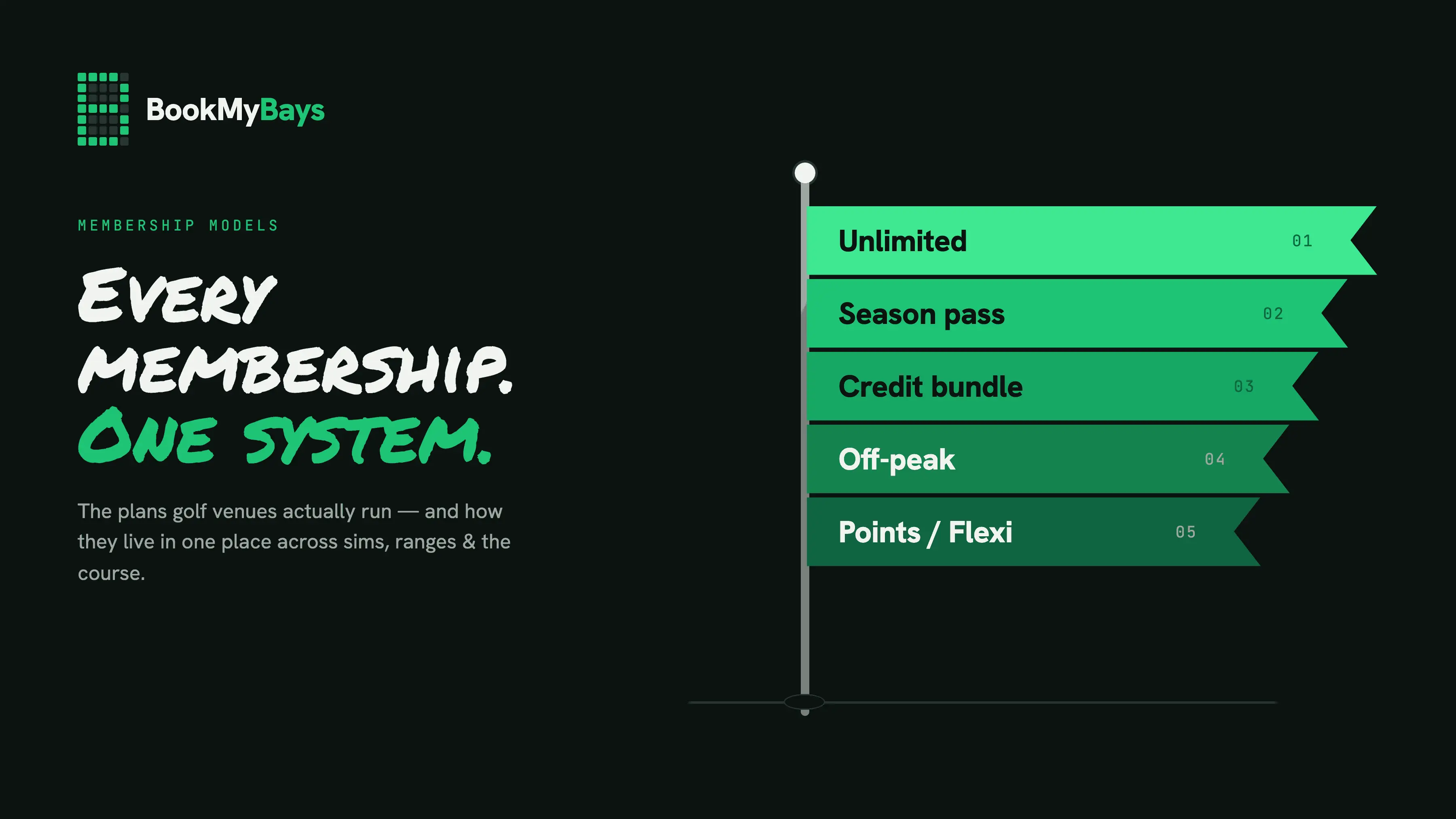
Strip away the venue type and almost every golf membership is one of five building blocks. Mix and match — most venues run two or three at once.
| Model | How it works | Best for |
|---|---|---|
| Unlimited | A flat monthly fee for all-you-can-play. The pull is “never think about the price again”. | Your heaviest users, and quieter venues that want to fill empty bays. |
| Credit / hours bundle | Pay monthly (or once) for a pot of credits — hours, sessions or ball baskets — drawn down per booking. | Regulars who play a known amount. The safest model for prime-time venues. |
| Off-peak / restricted | Cheaper plan that only works at quiet times — weekday mornings, before the after-work rush. | Retirees, shift workers, students. Fills your dead hours without touching peak revenue. |
| Season / term pass | A time-boxed pass — a winter sim pass, a summer range pass — that expires on a date, not a renewal. | Seasonal demand. Indoor sims in winter, ranges in summer. |
| Points / flexi | Buy a points balance and spend it however you like — peak rounds cost more points than off-peak. | Occasional players who won’t commit to “unlimited” but want a member’s rate. |
If you only run one, make it a credit bundle. It is the least scary to price, the kindest to your prime-time bays, and the easiest to explain at the counter.
How to run any of these in BookMyBays
Here is the bit where most “just use a spreadsheet” plans fall over: a membership is not really a price, it is a set of rules that have to be enforced every single time someone books, at 10pm, on a phone, with nobody on the desk. BookMyBays builds the plans and then does the enforcing for you.
- Recurring billing, built in. Monthly subscriptions, one-off credit bundles and time-boxed passes all run on Stripe — set the plan up once and the billing just happens.
- Credits with rollover caps. Sell hours, sessions or baskets, watch the balance draw down live, and cap how much rolls over so nobody banks a year of unused credit.
- Day-of-week and time-of-day restrictions. The off-peak plan simply will not book a Saturday prime slot. No staff member has to be the bad guy.
- Member self-service. Members buy, pause and resume their own plans — so a quiet month becomes a pause, not a cancellation.
- Member pricing on your booking page. Plans appear right where customers book, and member rates apply automatically at checkout — no codes to remember.
- Plans that cover extra players. A membership can pick up the mate they bring along, so group bookings do not break the deal.
A membership tracked in a spreadsheet is a membership your busiest member will quietly out-play by Tuesday — and you will not notice until the maths has already gone walkabout.
On the money side: BookMyBays charges a 1% fee on membership payments, because we run the recurring billing logic on top of Stripe. Ordinary bookings stay fee-free, and Stripe’s own card fees apply on top whichever way you take the money — see the full pricing for the exact sums.
What to charge: the back-of-a-beermat sum
Price a membership against the pay-as-you-go alternative, never against thin air. Take a sim bay at £30 an hour. An unlimited plan at £180 a month breaks even for the customer at six hours — so anyone playing weekly feels like they are winning, and you have locked in £180 you can count on whether the weather is grim or glorious.
The trick is to leave a little value on the table on purpose. A membership that only just beats pay-as-you-go is a calculator exercise; one that clearly beats it is a no-brainer your regulars tell their mates about. The maths should feel generous to them and still be comfortably profitable to you — because the member who turns up twice a week is also the one buying coffees, booking lessons and filling your quiet Tuesdays.
Four ways to get it wrong
Memberships are forgiving right up until they are not. The usual own goals:
Unlimited with no guard rails
Your keenest members camp on prime-time bays and crowd out full-price walk-ins. Add an off-peak tier or cap peak credits.
Pricing it too low
Set it under what your regulars already spend and you do not gain members — you give your best customers a discount.
No pause option
If members can only cancel, they will. A pause keeps them on the books through a quiet month.
Tracking it by hand
A spreadsheet cannot stop an off-peak member booking a Saturday, or notice when credits run dry. Rules only work if something enforces them.
Build your membership in an afternoon
Set up subs, credit bundles and off-peak plans, put them on your booking page, and let Stripe handle the billing. 14 days free, nothing locked off, cancel any time.
Frequently asked questions
How much should a golf simulator membership cost?
Most indoor golf simulator memberships land between roughly £80 and £250 a month, with the popular tiers around £150–£200. The number that matters is the break-even: an unlimited plan should cost a little less than the heavy user would spend paying as they go, and a credit plan should price each credit below your walk-in rate. As a rough rule, unlimited starts paying for the customer at about 8–10 hours of play a month.
What types of golf membership are there?
Five models cover almost everything: unlimited (flat fee, all-you-can-play), credit or hours bundles (a pot of credits drawn down per booking), off-peak or restricted (cheaper, quiet-times only), season or term passes (time-boxed, e.g. a winter sim pass), and points/flexi (buy a balance, spend it where you like). Driving ranges lean on ball cards and unlimited-balls plans; courses lean on 7-day, 5-day and flexible points memberships. Most venues run two or three side by side.
How do credit-based golf memberships work?
Customers pay for a balance of credits — hours, sessions or ball baskets — and each booking draws the credits down. Credits can renew monthly or be bought as a one-off bundle, and you can cap how many roll over so balances do not pile up forever. It is the safest model for a busy venue because members can only book what they have paid for, rather than camping on your prime-time bays.
Can I offer off-peak or weekday-only memberships?
Yes, and you probably should. An off-peak plan that only works at quiet times — weekday mornings, say — fills hours you would otherwise lose, without discounting the slots you can already sell at full price. The key is that the restriction is enforced automatically at booking, not left to staff to police.
Do golf memberships reduce no-shows?
They help. A member has already paid, so a missed session costs them, not you — the same logic as taking payment up front on a normal booking. Memberships also smooth your revenue into a predictable monthly figure and give your regulars a reason to come back rather than shop around.
Can members pause their membership?
With BookMyBays, yes — members can pause and resume their own plan from their account. This matters more than it sounds: a member who can pause for a quiet month stays a member, whereas a member who can only cancel often does, and does not come back.
Keep reading
Memberships reward your committed regulars — but to pull casual and occasional golfers back too, pair them with a loyalty program. Our guide to adding a loyalty program to your golf simulator booking software covers the other half of the retention picture. If you are still choosing the software underneath it all, our guide to the best booking software for indoor golf simulators walks through the eight things to check, and our honest comparisons show how the options stack up. And for the hours no membership will fill, there is selling the empty slot to whoever is already in the bay.
Written by The BookMyBays Team. BookMyBays builds booking, membership and access-control software for indoor golf venues, driving ranges and golf courses. The price ranges here reflect typical 2026 UK and US market rates and are meant as a guide, not a quote — your venue, your numbers.
Got a membership model we have not covered, or a figure that looks off? Email [email protected] and we’ll take a look. Last updated 3 June 2026.