Playbook
A golf loyalty scheme for your indoor golf venue, without the paper
Somewhere behind your bar there is a box of stamp cards. Half of them belong to people who have not been in since March. The other half are in coat pockets, in glove boxes, and in the bin. And on a busy Friday, nobody remembered to stamp the ones that did turn up.
The idea was always sound. The paper was the problem. An indoor golf loyalty scheme lives or dies on every visit being counted, and your booking system already knows every visit, every hour and every pound. It is the obvious place for the card to live.
Why golf loyalty programs work: two experiments worth knowing
Loyalty schemes are not just a nice gesture. Two well-known studies show why a card that fills up changes how people behave.
The first was at a car wash. Researchers handed out two kinds of card. One needed eight washes for a free one. The other needed ten, but came with two stamps already on it. Same eight washes either way, yet about a third of the head-start cards were finished, against a fifth of the empty ones. People are far more likely to finish something they feel they have already started.
The second was a café coffee card: ten coffees, the next one free. As customers got closer to the free coffee they came in more often, with the gap between visits shrinking by about 20 percent from the first stamp to the last. Give them a couple of bonus stamps and they finished the card in 12.7 days instead of 15.6.
That is the whole case for showing customers their progress. A card they can see, filling up, with the reward in the last box, is a reason to book the next session sooner.
Nobody books a quiet Tuesday for the sake of it. Plenty will book one to finish a card.
And repeat visits are where the money is. Bain & Company famously found that in financial services, a 5 percent rise in customer retention lifted profits by more than 25 percent. A sim venue is not a bank, but the direction is the same: a regular costs you nothing to find, and they bring their mates.
Choosing a golf loyalty scheme: stamps, points per pound or per hour
There are three sensible ways to count. A stamp card is the easiest to explain: one stamp a visit, a free hour after ten. Points per pound rewards the group of six more than the solo practice session. Points per hour rewards time in the bay, whatever you charged for it, which suits venues with a lot of off-peak pricing.
Whichever you pick, keep the first reward close. The car wash study is the warning: a card that looks half-done gets finished, and a card that looks endless gets forgotten.
What your customers see
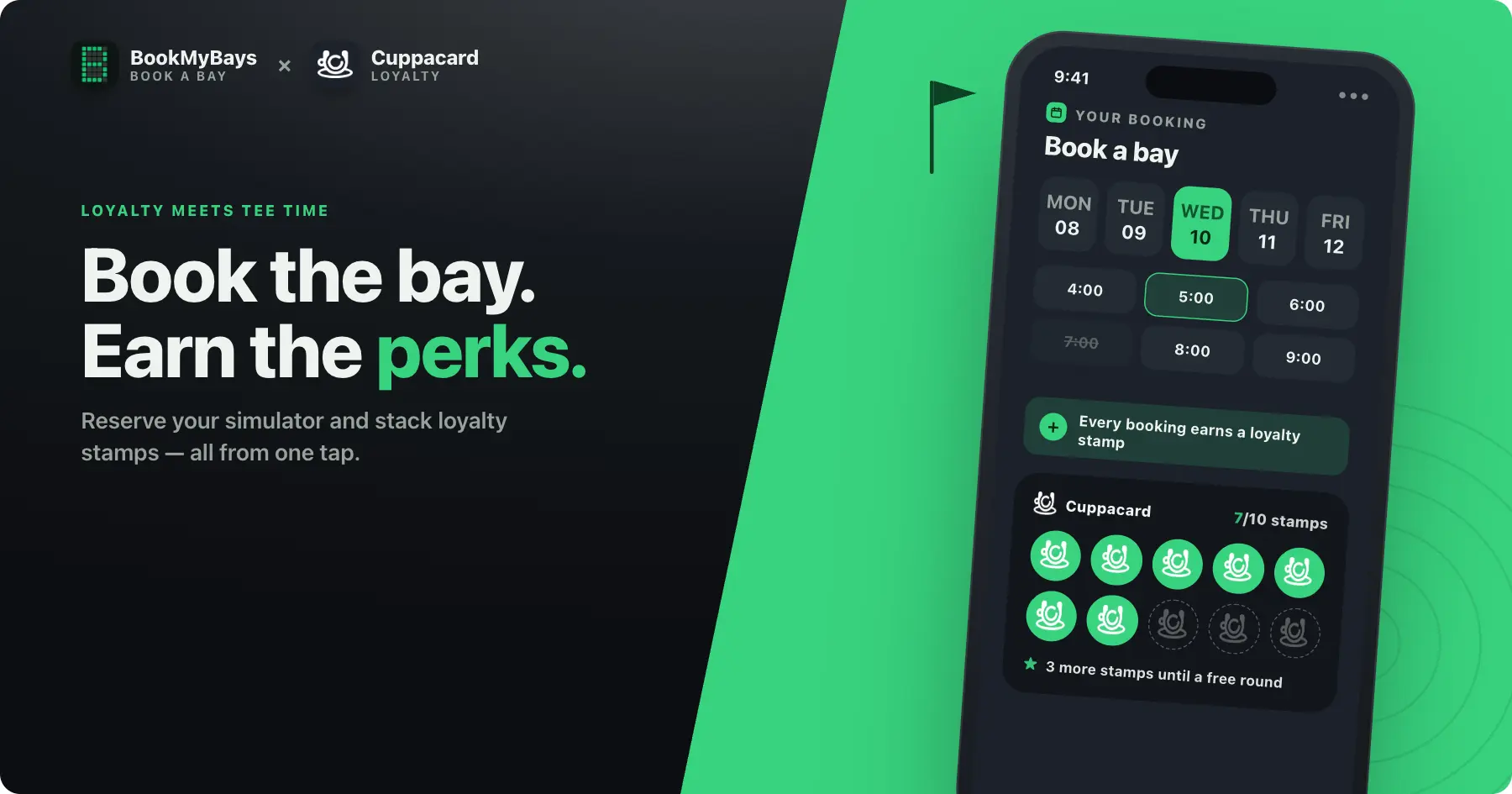
In BookMyBays the card lives on the customer’s account on your booking page. A stamp card looks like a stamp card, slightly crooked stamps and all. A points scheme shows the balance, each reward with how far there is to go, and a tilted “Ready” stamp on anything they can have now.
At checkout, signed-in customers pick a reward in one tap and see it come off the price. Every booking also says what it will earn, and tapping the number explains what it is worth: “about six visits like this” for a free hour.
Guests earn too. Their points are held against the email they booked with, and the confirmation invites them to create a free account to collect them. The first time a guest sees their points waiting is usually the moment they sign up.
Tiers for your regulars
Rewards bring people back for the next visit. Tiers keep your best customers feeling like your best customers. Bronze, Silver and Gold, reached by visits, hours or spend over the last twelve months, each with a standing discount, extra points, or both.
Make the first tier easy. Most of your regulars should reach Bronze without trying, because the point of Bronze is to make Silver look reachable.
Double points on quiet nights
Points are cheaper than discounts, and they do not teach anyone to wait for a sale. A points campaign gives double or bonus points on the days and times you choose, so Tuesday evenings become the smart time to play rather than the cheap one. It pairs well with selling the empty hour to the customer already in the bay.
What your staff see
The questions a loyalty scheme creates are always the same ones, usually at the bar on a busy night. Did I get my points for last week? Why didn’t that one count? Open the booking and the answer is there: points given, points still to come, or the plain reason why not.
Each customer has their own loyalty history too, and staff can add or remove points by hand with a note. Useful for the projector that died halfway through a session, or the regular who definitely did play last Thursday.
The awkward bits, handled
Every loyalty scheme eventually meets someone being clever, and the rules are what keep it fair:
- Refunds and cancellations take the points back, and a cancelled booking that used a reward gives those points back in full.
- Splitting one session into several bookings to collect more stamps is stopped by a daily limit you set.
- Points only land once the visit is paid for, and, if you like, only once the customer has checked in.
- Expiry is optional, and based on inactivity, so anyone who keeps coming back never loses a thing.
Indoor golf booking software with a loyalty scheme built in
In BookMyBays, the loyalty scheme is part of your indoor golf booking system rather than a separate app bolted on beside it. You choose how customers earn, add a reward or two, and switch it on under Settings → Features. From then on every booking counts, online, at the bay or at the desk, and your loyalty dashboard shows who is earning, what has been spent and what is still outstanding. It works the same for darts oches, pool tables and axe lanes as it does for sim bays.
Give your regulars a reason to come back
14 days free, nothing locked off, cancel any time. Flat monthly pricing with 0% commission on your bookings.
Frequently asked questions
What is the best loyalty scheme for an indoor golf venue?
For most indoor golf venues, a digital stamp card with a free hour after around ten visits is the best place to start: it is easy to explain, it works whatever people spend, and the first reward is close enough to chase. Add points per pound or per hour if your prices vary a lot, and Bronze, Silver and Gold tiers once you have a core of regulars. Whatever you choose, run it from your booking system so every visit is counted automatically.
Can indoor golf booking software run a loyalty scheme?
Some can. In BookMyBays the loyalty scheme is built into the booking system, so stamps or points are added from each paid booking, customers spend rewards at checkout, and staff see the points on every booking. A separate loyalty app works too, but it relies on someone scanning or stamping at the counter, which is the step that tends to get missed on a busy night.
Do loyalty programs actually work for golf simulator venues?
The research says the mechanism is real. In a published field study at a café, customers on a ten-stamp coffee card came in about 20 percent more often as the card filled up. A sim venue has the same ingredients: a product people buy again, a visit you can count, and a reward worth having. What usually breaks a loyalty scheme is the admin, not the idea: cards lost, stamps forgotten, and no record of who your regulars are.
Should I use a stamp card or points?
A stamp card is the simplest to explain and works whatever people spend. Points per pound reward bigger spenders and groups. Points per hour reward time in the bay regardless of price, which suits venues with lots of peak and off-peak pricing. If you are not sure, start with a stamp card and a free hour after ten visits.
What makes a good loyalty reward?
Something customers want and that costs you least at the times you are quiet. A free hour or a percentage off the next visit both work well, because they bring the customer back for another visit rather than handing out something they would have bought anyway. Keep the first reward within reach: a card that needs fifty visits is a card nobody finishes.
What is a digital loyalty card?
The same idea as a paper stamp card, kept on the customer’s account instead of in their wallet. Visits are counted automatically from bookings, so nobody has to remember to stamp anything, the card can’t be lost, and you can see who your regulars actually are.
Can guests earn loyalty points without an account?
In BookMyBays, yes. Points earned on a guest booking are held against the email address used to book, and they appear on the customer’s card the moment they create a free account with that email. Spending rewards needs them to be signed in, so it is always clear whose points are being used.
What happens to points if a booking is refunded?
They are taken back. Points are given once a visit has happened and been paid for, and a refund or cancellation reverses them automatically. If a reward was spent on a booking that is then cancelled, the points go back to the customer in full.
How do loyalty tiers work?
Tiers reward your most regular customers with something ongoing, usually a standing discount or extra points, once they reach a level of visits, hours or spend in the last twelve months. Bronze, Silver and Gold is the familiar shape. Keep the first tier easy to reach so most regulars get a taste of it.
Can I run double points on quiet nights?
Yes. In BookMyBays a points campaign gives extra or bonus points on the days and times you choose, which nudges regulars towards your quiet hours without cutting your prices.
Sources
- Nunes, J. C. and Drèze, X. (2006). “The Endowed Progress Effect: How Artificial Advancement Increases Effort.” Journal of Consumer Research, 32(4), 504-512.
- Kivetz, R., Urminsky, O. and Zheng, Y. (2006). “The Goal-Gradient Hypothesis Resurrected: Purchase Acceleration, Illusionary Goal Progress, and Customer Retention.” Journal of Marketing Research, 43(1), 39-58.
- Reichheld, F. (2001). “Prescription for Cutting Costs.” Bain & Company.
Related reading
- Golf membership models that work: sims, ranges and courses
- How to fill empty golf simulator slots
- Golf simulator membership software: what to check
Written by The BookMyBays Team. BookMyBays builds booking and access-control software for indoor golf venues, driving ranges and action venues. The study figures are the published ones, listed under Sources. The names, prices and balances in the screens above are made up.
Spotted something out of date? Email [email protected] and we’ll fix it. Last updated 25 October 2026.